“Ensuring that all this new load growth which is coming in the next few years is able to be added in a sustainable way that doesn’t result in blackouts, that doesn’t result in surging electricity prices, that’s got to be the biggest [benefit of energy storage].“
Iola Hughes, Head of Research, Benchmark Mineral Intelligence
Battery energy storage is playing an increasingly critical role in America’s power grids, securing reliable and affordable power for homes and businesses during periods of extreme weather and heightened demand. Iola Hughes is the Head of Research at Benchmark Mineral Intelligence (BMI) and joins Good Energy to discuss the key findings and takeaways from the inaugural Energy Storage Market Outlook (ESMO) report co-produced by BMI and SEIA.
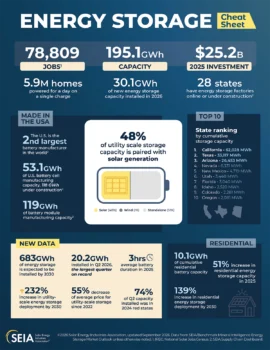
The report, which will be released on a quarterly basis, breaks down findings by installation scale and battery chemistry, finding that the U.S. added a record 57.6 gigawatt hours (GWh) of battery storage capacity in 2025 and is expected to have 600 GWh in total capacity by 2030.
The report additionally discusses domestic battery manufacturing, and Hughes notes that recent downturns and tax credit expirations in the electric vehicle market is prompting those suppliers to shift their production lines to stationary energy storage instead. This pivot alone doubled BMI’s projection for total battery capacity by 2030, which they forecast based on their database of projects in the pipeline and other variables related to the economy and the outlook for the electric grid and its supply mix.
Hughes notes that utility-scale storage made up the majority of America’s storage growth, with installation capacity in California, Texas, and Arizona leading the nation, while increased solar deployments in New Mexico, Idaho, and Wisconsin notably drove storage capacity in all three states past one GWh.
Looking at the residential market, Hughes notes the 50% growth due to the expiration of the 25D residential solar tax credit. However, households will continue to see the appeal of batteries to keep their lights on during extreme weather or other grid outages.
A unique element of the ESMO report is its data breakdown of different battery chemistries. Hughes explains that lithium iron phosphate (LFP) batteries have come to dominate the market in the last 3-4 years. Looking at the long-term forecast, Hughes predicts a greater mix of battery chemistries thanks to sodium-ion batteries and several more novel forms of batteries, while LFP batteries will remain the leading type. Hughes gives a brief breakdown of battery supply chains and the work being done to onshore battery sourcing.
Hughes concludes by touting the stability that storage contributes to grid management as a key takeaway that policymakers should keep in mind when legislating on energy.
Listeners interested in learning more about the Energy Storage Market Outlook and purchasing the full report can visit https://seia.org/esmo.
From in-depth interviews with industry leaders to insightful discussions on the rapid growth of solar and storage in the United States, Good Energy connects you with the heartbeat of the solar industry. Whether you’re a seasoned professional or just curious about the future of energy, tune in to stay informed and inspired about the bright future of solar. Listen to full episodes on YouTube, Spotify, and Apple Podcasts.
 |
 |
special guest
Iola Hughes
Head of Research
Benchmark Mineral Intelligence
Iola is Head of Research at Benchmark, following its acquisition of Rho Motion, where she has worked since the company’s inception. Her work spans across the battery demand sectors, from electric vehicle to stationary storage forecasting, managing the team’s view of battery demand and chemistry, and considering the influence of key variables from legislation to OEM strategy and technology roadmaps. Rho Motion was acquired by Benchmark Mineral Group in 2024, establishing the first dedicated end-to-end data and market intelligence firm covering the energy transition from mine to grid.

good energy
Meet Our Podcast Hosts


podcast
All Resources ->Watch More Good Energy






related content
You May Also Like