Why Solar + Storage Are Central to Meeting President Trump’s Energy Priorities

One reality remains top of mind for American families:
Electricity demand is surging, prices are rising, and America needs more power, not less.
In 2025, U.S. electricity prices rose 6.9% on average, more than double the overall inflation rate. According to Goldman Sachs, Americans could see another 6% increase in electricity prices over the next two years as AI, electrification, and advanced manufacturing drive historic increases in electricity demand.
The Trump administration has made clear that its energy dominance vision prioritizes affordable, reliable, secure power. If we’re going to achieve that vision, solar and storage must be at the center of the solution.
Here’s why…
1. Affordability
The best way to put downward pressure on rising energy prices is with more supply. And building it quickly.
Energy buyers, utilities, and private investors are overwhelmingly choosing solar and storage because they are the lowest-cost and fastest-to-build resources available.
It’s simple economics. In 2025, solar and storage accounted for 84% of new power capacity added to the grid, with the majority built in states that voted for President Trump.
Whether it’s installed on your rooftop or near your community, solar has zero fuel costs, which insulates the system from the price shocks that other energy sources tied to global commodity markets experience. When paired with batteries, it delivers more stable, predictable electric bills for families and businesses.
2. Reliability
“Baseload” power is an outdated concept. Modern grids can’t run on only big, inflexible plants. They need flexible, fast, and diverse resources. That’s why energy storage is booming.
In 2025, the United States installed a record-shattering 58 GWh of new energy storage capacity, 4x what the industry installed just three years ago. Energy storage is growing at historic rates because it delivers what the market is demanding: affordable, flexible, reliable power that strengthens a modern, resilient energy system.
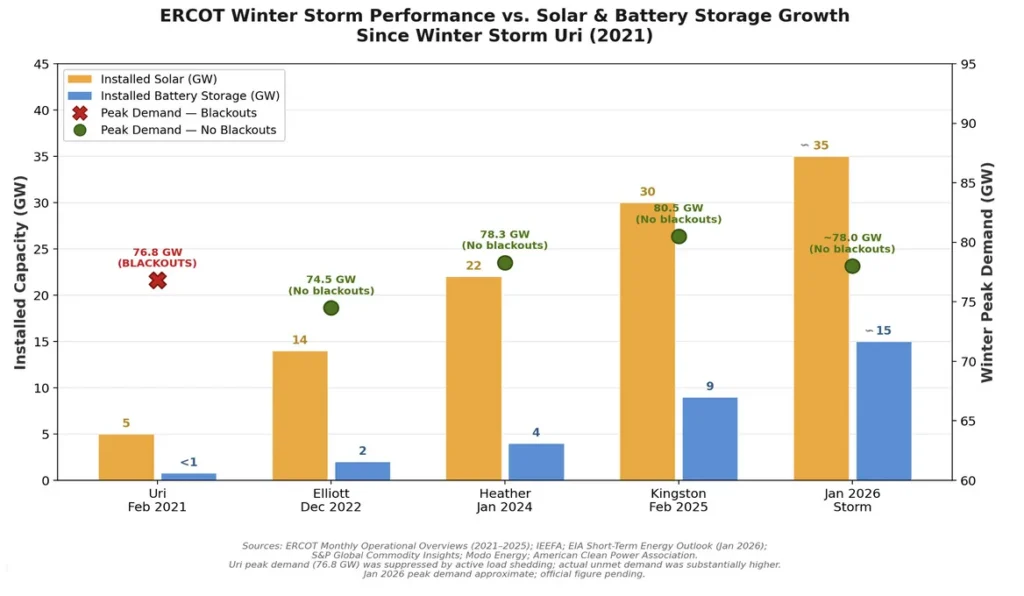
States like Texas have proven that solar + storage is critical for keeping the lights on. After Winter Storm Uri, which froze power plants and caused natural gas supply lines to fail across the state in 2021, the state has gone all in on solar and energy storage. It is now the fastest-growing solar market in the country and the second-largest storage market.
The result? In major winter storms since Uri, during all-time winter peak demand records, the system endured. That’s the power of solar and energy storage.
3. Energy Security
Unlike fuels tied to volatile global commodity markets, solar is not subject to geopolitical shocks or price swings. Its fuel is free, abundant, and delivered daily. That price stability is a powerful, and often overlooked, energy security advantage.
At the same time, American solar and storage manufacturing is booming. In 2025, the United States added 15.1 GW of new solar module manufacturing capacity. With the opening of a new silicon wafer facility in Michigan last year, the U.S. can now produce every major component of the solar module supply chain for the first time in years.
This manufacturing boom extends beyond just the solar modules. In 2025, domestic inverter manufacturing grew by 50%, and the U.S. added over 21 GWh of new battery cell manufacturing capacity.
In 2017, the United States ranked 14th globally in solar manufacturing. Today, we rank third globally for solar manufacturing and second for battery energy storage manufacturing.
True energy independence means owning the full supply chain in the United States, from raw materials to finished products to recycling. Solar and storage are rapidly becoming a made-in-America success story, strengthening our economic competitiveness and our national security.
4. Meeting Rising Demand
The Trump administration’s AI agenda is driving historic growth in electricity demand. But at the same time, the administration is tying up hundreds of solar and storage projects in a web of red tape and permitting bureaucracy.
Political attacks are endangering nearly 500 solar + storage projects on federal and private lands, representing nearly half of all planned power in the U.S. The resulting policy uncertainty is destabilizing the energy industry and chilling investment. And because natural gas plants take 3–5 years to build and nuclear reactors take 10+ years, these delays are preventing us from meeting rising demand.
The result will be higher energy costs for American families and businesses. We cannot claim to be the global AI leader while blocking our fastest-growing, lowest-cost, and quickest-to-build sources of new electricity.
If bipartisan permitting reform is on the table, it must begin with ensuring the processes cannot be weaponized against the very technologies delivering affordable power at scale.
Solar and storage is surging in red and blue states alike, driving American manufacturing, strengthening energy independence, lowering costs, and enhancing grid reliability.
As President Trump reevaluates the country’s energy priorities, one thing should be clear:
If we want affordable, reliable, secure American energy, the path runs straight through solar and storage.
related content
You May Also Like