From the Gridiron to the Grid: Five Solar Stadiums Powering NFL Sundays
Football is back and, as millions of fans pack into stadiums to watch their teams, another all-American powerhouse will be energizing their experience: solar and energy storage.
From 10,000 panels in Philadelphia to a 100%-solar stadium in Las Vegas, NFL teams are showing just how mainstream solar has become. Solar is powering American homes and businesses, factories, farms, and, increasingly, football Sundays.
Here are five NFL stadiums putting solar to work.
1. Lincoln Financial Field — Philadelphia Eagles
The Philadelphia Eagles have one of the NFL’s most impressive on-site solar installations.
More than 10,000 solar panels surround Lincoln Financial Field, producing approximately 4 megawatts (MW) of clean energy and supplying about 40% of the stadium’s annual electricity use. Since the system was installed in 2013, it has generated more than 32 gigawatt-hours (GWh) of electricity. Combined with the organization’s 14 wind turbines, clean energy generates over six times the power needed for the Eagle’s home games.
2. Allegiant Stadium — Las Vegas Raiders
The Las Vegas Raiders took a different approach to solar.
In 2023, Allegiant Stadium became the first NFL stadium to operate entirely on renewable energy supplied through its partnership with NV Energy. That electricity comes from renewable resources in Nevada, including the 200 MW Arrow Canyon Solar + Storage project, which pairs solar with 75 MW of battery storage.
The system also helped supply the electricity used by Allegiant Stadium when Las Vegas hosted Super Bowl LVIII in 2024.
3. Mercedes-Benz Stadium — Atlanta Falcons
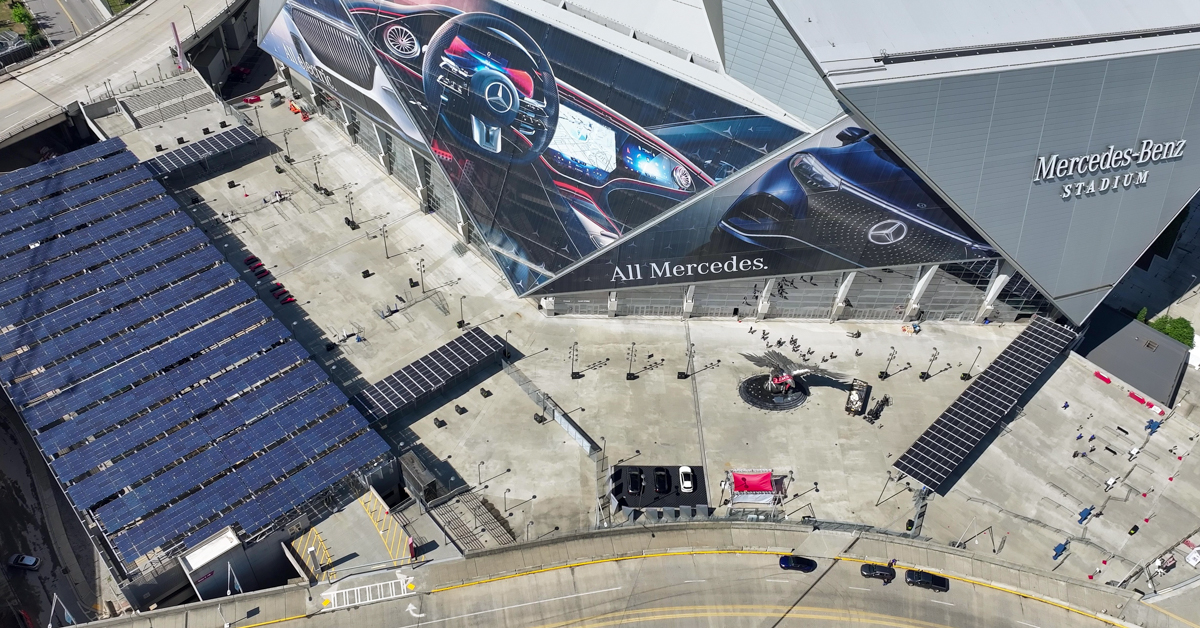
More than 4,000 solar panels are installed across the Mercedes-Benz Stadium and Georgia World Congress Center campus in Atlanta. Together, they generate approximately 1600 MWh of electricity annually — enough to power the Falcons’ nine home games. The excess electricity generated by the panels flows onto Georgia Power’s grid, where it helps serve customers throughout the region.
“Our goal is to collect enough renewable energy each year to power more than nine Atlanta Falcons home games and 13 Atlanta United home matches. And with the solar program we have in place we feel confident we’ll achieve this and more,” said Scott Jenkins, general manager of Mercedes-Benz Stadium.
4. Levi’s Stadium — San Francisco 49ers
When Levi’s Stadium opened in 2014, solar was built right into its design.
More than 1,150 solar panels are installed on the stadium’s NRG Solar Terrace and three pedestrian bridges, creating a 375 kilowatt (kW) solar system. The installation can generate enough electricity over the course of a year to offset the electricity consumed during the 49ers’ regular-season home games.
Those panels helped power Super Bowl 50 in 2016 when Levi’s Stadium hosted the Big Game.
5. MetLife Stadium — New York Giants and New York Jets
Even the NFL’s only stadium shared by two teams gets in on the solar action.
MetLife Stadium, home of the New York Giants and New York Jets, features on-site solar generation as part of its broader energy conservation efforts. According to the stadium, its solar installations have generated more than 2,770 MWh of electricity. That makes solar part of the infrastructure supporting one of the busiest stadiums in professional football.
Solar Is Ready for Game Day
NFL stadiums are just one highly visible example of a much bigger trend. Across America, solar and storage are supplying electricity everywhere from kitchen tables to factory floors — and now some of the biggest stages in American sports.
So, when your team takes the field this season, don’t forget to look up. The sun might be helping power your game day.
related content
You May Also Like