Updated October 2026
Solar & Storage Supply Chain Dashboard
Energy Leadership
Introduction
U.S. Solar & Energy Storage Manufacturing Surging
Strength in the U.S. solar and storage manufacturing ecosystem reduces supply chain uncertainty, drives clean energy deployment, builds local economies through job creation, and strengthens America’s energy security.
Federal policies that directly support domestic manufacturing (Section 45X tax credit, Section 48C tax credit), solar deployment incentives (ITC and PTC), and policies that encourage demand for domestic products (domestic content adder credit) have worked in tandem to lead to a surge in U.S. solar and energy storage manufacturing investments. These incentives help make American solar and storage manufacturing more competitive in the global market.
Full dataset is available to SEIA Kilowatt-level membership and above →
Manufacturing Data
-
Operational U.S. Module Manufacturing Capacity:
75.3 GWdc
-
U.S. Module Manufacturing Capacity Can Supply:
All (176%) of Expected 2026 U.S. Demand
-
Operational U.S. Battery Cell Manufacturing Capacity:
62.4 GWh
-
Total Invested Since August 2022:
$41.9 Billion
-
Total Potential U.S. Manufacturing Jobs:
74,626


Supply Chain Overview
A New Era for U.S. Manufacturing
Since 2023, new policies have driven a broadening base of both established and first-time investment in domestic suppliers, as more key inputs and materials are processed or manufactured in the United States than ever before.
New manufacturing announcements reflect a fundamental shift in the domestic energy supply chain, resulting in:
Current Capacity
Solar and storage manufacturing have both grown drastically since the federal manufacturing tax credits were introduced in August 2022. Solar manufacturing has grown across all segments, and now there’s enough module manufacturing capacity to serve the whole U.S. market. If all battery factories come online as expected, the U.S. will have enough battery cell and module manufacturing capacity to serve the whole U.S. market by the end of 2027.
Tracking the Buildout of the U.S. Solar & Storage Supply Chain
The Solar and Storage Supply Chain map is updated to reflect U.S. solar and storage manufacturers that are announced, operational, and under construction. Industry specific data underpinning the Supply Chain Dashboard is available to SEIA members with Kilowatt status and above.

Manufacturing Tax Credits Inspire Growth
Since the passage of new manufacturing tax credits, there have been significant investments into the expansion of the whole solar module supply chain. Cell manufacturing capacity is expected to continue to grow. Module manufacturing has seen the strongest growth with over 700% increase in capacity as of June 2026.
The federal manufacturing tax credits have resulted in billions of dollars in solar and storage manufacturing investment. These investments help grow the economy, support communities, and provide thousands of good paying jobs for Americans. Manufacturing jobs at announced facilities have also doubled since the manufacturing tax credits were codified.

True energy independence means owning the full supply chain in the United States. Solar and storage are rapidly becoming a made-in-America success story, strengthening our economic competitiveness and our national security.
Tim Pawlenty / President & CEO
Disclaimers
This product reflects only the publicly available data underpinning SEIA’s Solar and Storage Supply Chain dashboard. As a result, there may be some differences between the data in this file and aggregate data published on the SEIA website which may include non-public information. The data is collected from press releases, news articles, member submissions, and other sources. Additionally, facilities that SEIA has determined to be unlikely to move forward have been removed from the public data sheet.
We provide this data and map as-is and do not guarantee its accuracy or completeness. It is meant for informational purposes only. The user of the data assumes the entire risk associated with its use of these data. SEIA shall not be held liable for any use or misuse of the data described and/or contained herein. The user of the data bears all responsibility in determining whether these data are fit for its intended use.
* SEIA’s Supply Chain Dashboard does not track upstream mining but tracks the midstream processing of anode and cathode materials in the battery materials category and downstream assembly with battery cells and battery packs.
**SEIA’s Supply Chain Dashboard currently excludes manufacturing facilities designed specifically for electric vehicles, and numbers reflect manufacturing capabilities for residential storage, utility-scale storage, and facilities that serve both the BESS and EV market. While EV-focused facilities are currently excluded, much of the supply chains are the same and contribute to the same domestic manufacturing ecosystem, network effects and economies of scale.
Suggestion Form | Full dataset available to SEIA members at the Kilowatt tier and above. | Contact
Already a SEIA member? Not at our Kilowatt-level of membership to access this full resource? Contact us today →
Solar Module Supply Chain
There are two main module technologies that serve the solar market: thin film and crystalline silicon. Thin film module production uses a monolithic manufacturing process where photovoltaic materials are deposited onto a substrate such as glass. Crystalline silicon (c-Si or CSPV) module production is a multistep process that includes polysilicon, ingots, wafers, cells, and modules.
The module supply chain includes polysilicon, ingots, wafers, photovoltaic (PV) cells, modules, glass, backsheets, PV wire, encapsulants and more.
U.S. Solar Manufacturing
Prior to the manufacturing tax credits, there was 50,000 MT of polysilicon manufacturing capacity and 7 GW of module manufacturing capacity, with no ingot, wafer, or cell manufacturing online. Since the tax credits were implemented, has been growth across all segments of the c-Si module supply chain. Polysilicon capacity that had been idled has been dedicated for solar deployment, and the first ingot and wafer manufacturing facilities came online in October 2025. In 2024, cell manufacturing capacity was reshored for the first time since 2019, and module manufacturing has grown nearly 800% since August 2022.
Solar Module Supply Chain
The module supply chain includes polysilicon, ingots, wafers, photovoltaic (PV) cells, modules, glass, backsheets, PV wire, encapsulants and more.
Storage Supply Chain
Battery cells are individual units that contain the essential components of a battery, while battery modules are groups of cells connected to meet power and energy needs for a given application. The storage supply chain includes battery materials such as anode and cathode materials, electrolyte, battery cells, and battery modules.
Once the battery modules are put together, they are put into a Battery Energy Storage System (BESS), along with a power conversion system (PCS), electrical components, and monitoring systems.
Building a Domestic Battery Supply Chain
Prior to the passage of federal manufacturing tax credits, there was limited American storage manufacturing designated to serve our battery energy storage system (BESS) market. Since, there has been an expansion in battery manufacturing for the BESS and EV markets, specifically upstream (mining)*, midstream (processing), and downstream (assembly). Battery cell and module facilities have begun to come online, introducing 62.4 GWh of battery cell manufacturing and 109.6 GWh of battery module manufacturing capacity to the grid.
Midstream processing for cathode and anode active materials have been slow to grow as low demand, expensive capex, and minimal federal tax incentives have hindered growth. Additional cell and module capacity expected online over the next few years, as many former EV factories are transitioning lines to serve the stationary storage market. The EV to stationary storage transition takes 6 to 18 months, so many of these lines are expected to come online in late 2026 or early 2027. Many factories that were formerly dedicated to batteries for EV production are now transitioning to supplying cells for stationary storage use. If all factories proceed as planned, the U.S. will have enough battery cell and battery module manufacturing capacity to serve the entire domestic market by the end of 2027.
Domestic Storage Manufacturing Supply
The Supply Chain Dashboard shows CAM, AAM, electrolytes, battery cells, battery modules, fully completed BESS, battery containers, and lithium hydroxide refineries.
Solar Mounting Systems
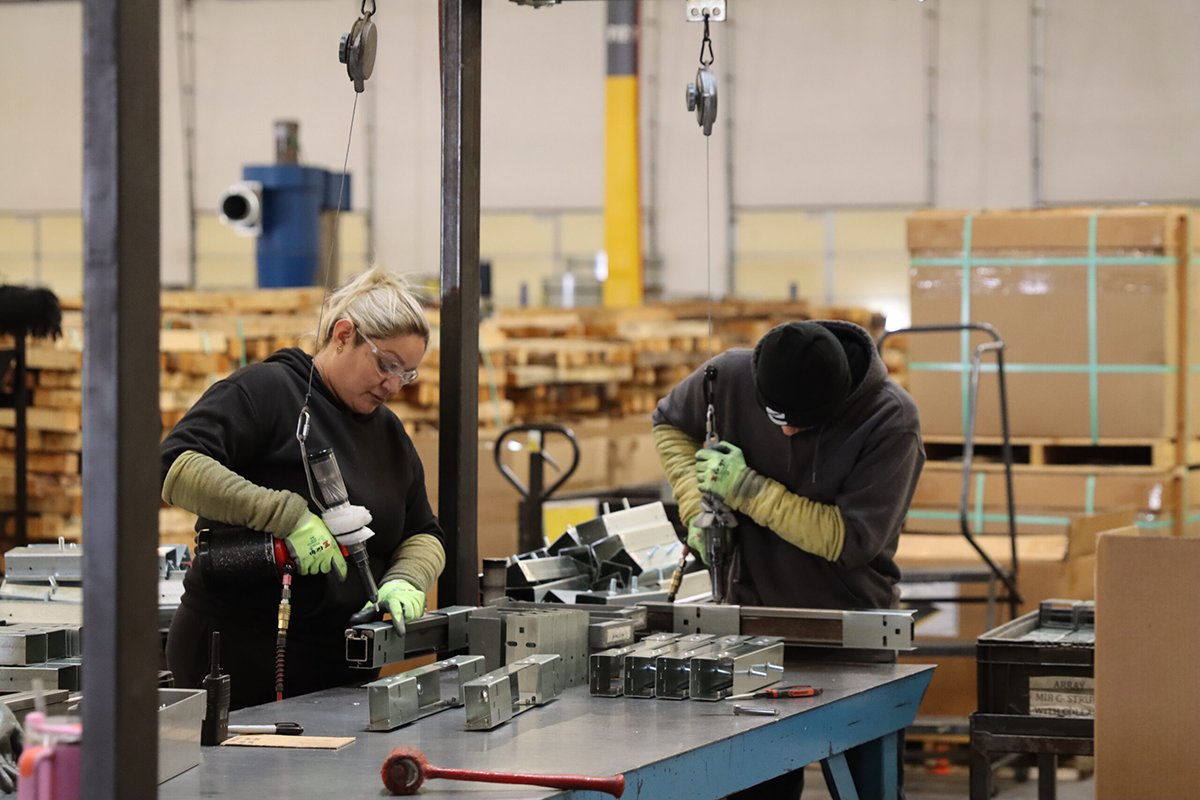
Mounting systems are the structural backbone of a solar project. They securely attach solar panels to rooftops or the ground, ensuring systems can withstand wind, snow, earthquakes, hail, and other environmental conditions throughout their operating life.
Solar Mounting System Components Explained
The U.S. mounting system supply chain manufactures a wide range of structural components, including structural balance of systems (SBOS) and racking. SBOS include rails, mounts, support beams, torque tubes, piles, foundations, spacers, ballast systems, wind deflectors, dampers, and mechanical drive components used in solar trackers. Racking includes:
- Fixed-Tilt systems which hold solar panels at a fixed angle throughout the day and make up about 18% of the ground-mount market
- Single-axis trackers which rotate solar panels form east to west to track the sun and make up about 80% of the ground-mount market.
- Dual-axis trackers which rotate solar panels both east to west and north to south and make up about 2% of the ground mount market.
Power Electronics and Grid Technologies
Solar panels and battery cells produce direct current (DC), while the electric grid operates on alternating current (AC). Power electronics convert, control, and safely deliver electricity from solar and storage systems to the grid. Power electronics include inverters, transformers, junction boxes, electrical balance of systems (eBOS) and other electrical components.
Power Electronics Use Cases
Modern inverters and power electronics do much more than convert electricity. They monitor system performance, regulate voltage, respond to changing grid conditions, protect workers and equipment during outages, and increasingly help stabilize the grid as renewable energy deployment grows.
As solar and battery storage become a larger share of the electricity mix, power electronics are playing an increasingly important role in maintaining a reliable and resilient electric grid.
Understanding Inverters
Building more inverters in the U.S. is important for protecting American cybersecurity.
Different inverters are used for different projects based on the technical and economic needs. Shading, the size of a project, battery attachment rate, and the budget for a project all impact what type of inverter is best to use for a solar array.
- Microinverters are used in residential systems and there’s one inverter per solar panel.
- String inverters convert a string of solar panels from DC to AC at one location and are common in commercial and some smaller ground mount systems.
- Central inverters are designed to manage electricity from hundreds or thousands of solar panels. These are common in larger ground mount systems.
- Hybrid inverters are used for ground mount projects that combine solar and storage. These inverters help manage battery charging and discharging.